

Network Analysis in the Humanities
Network Analysis in the Humanities
May 6-8, 2026. Tartu, Estonia
All spots for the workshop have been taken. In case you’d like to register to join the waiting list, contact us at loone.vilumaa@ut.ee.
Slides of the presentations can be viewed here.
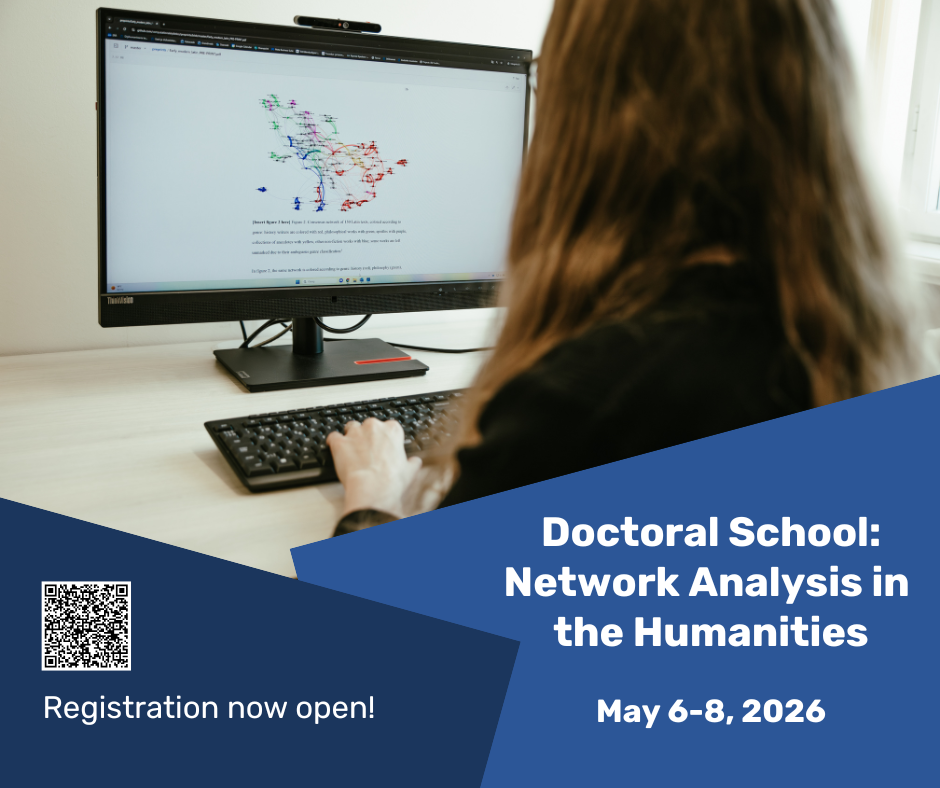
The workshop introduces participants to the application of network theory in the humanities, with a particular emphasis on linguistics, as well as literary and cultural studies. The first day begins with an introductory lecture that offers a conceptual and methodological overview of the field, outlining key concepts, models, and research questions. This is followed by presentations from experts who demonstrate how network-based approaches can be applied to different kinds of data and research problems. The second and third day of the workshop are dedicated to the transfer of practical skills. Participants will learn essential techniques for data preparation, including visualizing networks in ways that support exploration, interpretation, and scholarly communication.
The program also includes hands-on workshops on data preparation, data visualisation and using network metrics to describe networks and nodes. Participants will also be introduced to the use of Gephi, one of the most widely used network visualization tools, which offers a broad range of methods for highlighting important structural properties of networks.
The 3-day workshop is aimed for PhD and MA students as well as academic staff from Estonian universities. It’s possible to gain 2 ECTS for participating at the event (requires additional reading, the reading list will be sent to registered participants).
Preliminary timetable:
Day 1 – Introduction, Possibilities, Examples (Ülikooli 18-139)
10.30-11.00 Welcome coffee & introductions
11.00-12.30 General Introduction to Network Theory and History (Thiago D. Oliveira)
12.30-14.00 Lunch break (lunch not provided)
14.00-14.30 Research presentation (Botond Szemes)
14.30-15.00 Research presentation (Prof. Maciej Eder)
15.00-15.30 Coffee break
15.30-17.00 Keynote speech (Matteo Romanello)
19.00 Dinner for all lecturers & participants
Day 2- Creating Networks (Jakobi 2-428)
9.30-12.00 Workshop on Data preparation (SPARQL, TEI XML, Excel) (Matteo Romanello)
12.00-13.30 Lunch break (lunch not provided)
13.30-15.00 Workshop on Network visualization: Gephi. Part I (Prof. Maciej Eder)
15.00-15.30 Coffee break
15.30-17.00 Workshop, part II (Prof. Maciej Eder)
Day 3 – Calculation and Consultation (Jakobi 2-106)
9.30-12.30 Consultation (students’ ideas, difficulties). (Matteo Romanello, Botond Szemes, Thiago D. Oliveira, Prof. Maciej Eder)
12.30-14.00 Lunch break (lunch not provided)
14.00-15.30 Workshop on using network metrics to describe networks and nodes. Part I (Botond Szemes)
15.30-16.00 Coffee break
16.00-17.00 Workshop, part II (Botond Szemes)
Participants coming from outside of Tartu will be offered accommodation. Additionally, coffee breaks and a joint dinner are covered by the organisers of the event. Lunches are not provided. Participants are expected to join with their own laptops. Previous knowledge of programming is welcome but not mandatory.
Lecturers include Matteo Romanello (University of Zurich) and Maciej Eder, Botond Szemes and Thiago D. Oliveira (University of Tartu):
Matteo Romanello is a Senior Data Engineer at the Swiss Art Research Infrastructure (SARI), University of Zurich. Before joining SARI, Matteo Romanello was Senior Lecturer at the University of Lausanne, where he conducted a project focused on the history of classical commentaries (Ajax Multi-Commentary). He holds a PhD in Digital Humanities from King’s College London (2015) and has carried out research in national and international research projects at the intersection of humanities and computer science/NLP, including work on citation mining, information extraction (especially named entity processing), and text reuse detection. Previously, he worked as a post-doctoral researcher at EPFL (2015-2020), as a teaching fellow at the University of Rostock (2017-2018), as a researcher at the German Archaeological Institute (2011-2017), and he was a visiting research scholar at Perseus project, Tufts University (2008-2009).
Maciej Eder works as Visiting Professor in Digital Humanities at the University of Tartu, and Professor in Linguistics at the Institute of Polish Language (Polish Academy of Sciences). Currently, he is also the Chair of the Committee of Linguistics at the Polish Academy of Sciences, co-founder of the Computational Stylistics Group, the main developer of the R package ‘Stylo’ for performing stylometric analyses, and an elected member of the Polish Academy of Arts and Sciences (PAU). While Maciej’s background is Early Modern literature, specifically the 17th-century Polish and Latin prose, his career path was shaped by a few unexpected twists, including a position of a lexicographer (working on the 15th-century Polish), and then a researcher in quantitative linguistics (exploring language change). Currently, Maciej’s main research area lays somewhere between literary studies and linguistics, and revolves around computer-assisted text analysis and quantitative approaches to style variation. These include measuring style using statistical methods, authorship attribution based on quantitative measures, as well as ‘distant reading’ methods to analyze dozens (or hundreds) of literary works at a time.
Botond Szemes is a research fellow in Digital Humanities and holds a PhD in Literary Studies. He previously worked at the Institute for Literary Studies (Department of Literary Theory) in Budapest, Hungary. His research explores computational approaches to literature, including stylometry, quantitative drama analysis and network theory, as well as the role of statistical methods and data visualization in knowledge production. His 2024 book offers the first Hungarian overview of computational literary studies. He is secretary of the Hungarian Comparative Literary Studies Association and a member of the ICLA Digital Comparative Literature Committee.
Thiago Dumont Oliveira is a research fellow in Digital Humanities at the University of Tartu and a research associate at the Centre of Latin American Studies, University of Cambridge. He holds a PhD in Economics from the University of Siena and has held postdoctoral fellowships at the University of Basel, the University of Turin, and Arizona State University. His research agenda focuses on political economy, sustainable development, and computational linguistics. He is currently investigating the coevolution of theories, practices, and conceptions of sustainable development in Brazil since 1930.
The event is organised with the support of the Estonian Doctoral School (Project “Cooperation between universities to promote doctoral studies” (2021-2027.4.04.24-0003) is co-funded by the European Union). The event is organised by DigiTS (Center for Digital Text Scholarship, funded by the European Union) operating at the University of Tartu Institute of Estonian and General Linguistics and the University of Tartu Institute of Foreign Languages and Cultures, Department of Classical Studies. The organisers include Prof. Liina Lindström and Prof. Janika Päll.
Additional information: loone.vilumaa@ut.ee

